Saturday, May 27, 2023

The Pillars of the OSR, Part I: Journeys

 why am I doing this now I just completely rewrote my rules Goddammit fuck

D&D 5e talks a lot about its "three pillars" of exploration, socialization, and combat. A big part of the problem with 5e is that it only provides real mechanical support for one of those supposedly foundational gameplay modes, combat. The exploration and socialization are pretty much left to the DM to figure shit out.

I think 5e is a pretty shit game. But I've been thinking lately about the value of defining similar "pillars" when designing other RPGs. I think it's good, when making a game, to think about what kinds of things you want the players and PCs to be doing regularly and design around those activities. That probably sounds obvious, but a lot of games don't do this. The big problem with "core mechanic" systems in my experience, where everything is resolved with the same dice mechanic, is that they often start by thinking about their core mechanic in abstract, as dice and numbers without fictional context, and then try to bend it to apply to all sorts of different fictional situations. At the same time, I think a lot of OSR does the opposite. OSR tends to be very anti-core mechanic, we like having unique procedures for every activity that reflect how we want that specific activity to work. But sometimes, at least for me, it can feel like some of those procedures easily could work on a more consistent set of mechanics, but don't, largely out of respect for tradition (or just wanting to roll all the dice). I don't think that's always a good thing--I think having consistency in mechanics is useful, it helps make the game intuitive and rules easier to remember--just as long as the pursuit of mechanical consistency doesn't compromise the important distinctions between fictional activities.

So what are the core activities, the "pillars," of OSR? I think they're pretty consistent. I see the game usually breaking down into five main modes, which I'm going to call journeys, dungeons, socialization, combat, and magic. You could have downtime in place of magic; I'll talk about why I say this when I get there. Further, I think each pillar is usually supported by a pretty consistent set of core activities, stuff adventurers will end up doing regularly in the vast majority of games. I think by breaking these down, and by considering what factors--in the fiction and at the table--usually do or should play into how they turn out, we can make our procedures better.

It's also an important OSR principle that a game shouldn't substitute character competence for things that can be simulated well by player competence. We all hate the idea of players magicking their way through a negotiation with an NPC by rolling diplomacy when talking is perfectly practical; conversely, we're generally more okay with characters' fighting skills mattering in combat, because most of us aren't about to break out the boffer weapons whenever initiative happens. And even if we were, I personally like the idea of players being able to play character who are much better (or worse) martial artists than they are in real life. OSR should require players to be good at some things to do well, like memory and lateral thinking, but many things, I think, can and should be left to character competence--otherwise we'd LARP. I think one benefit of breaking down the core activities of the game this way, and what factors they should rely on, is that it can help us hone in on what properties of a player should matter to the game versus what properties of a character, and thus avoid having mechanics hanging awkwardly off our characters that either don't really do anything or require us to invent extraneous procedures to justify their presence.

Journeys

You might call this overland travel, wilderness exploration, or whatever. I like to think of it in terms of journeys because the main thing I want it to evoke is the long treks of Tolkien's fellowship. They were journeying toward a known goal, not exploring an unknown place, but it's all similar enough for our purposes.

Journey play is relatively abstracted. You can often cover one or more days of travel in a couple minutes of real time. Some games go so far as to basically ignore journeys--you say the party travels for X days and then they arrive where they want to be. I like journeys to be important. I usually see them as what adventurers spend most of their time doing, even if little of it is played out. Getting to the dungeon is usually just as big a part of the adventure as the dungeon itself--after all, if the dungeon were easy to reach, someone else probably would've gotten there first. If a game doesn't have good journey procedures, I think it's weaker for it.

The core activities I see as part of journeys are:

Hiking and Riding

The heart of it, move your ass from point A to point B. Usually pretty simple, but if you've ever backpacked anywhere, you know it's not easy. Fantasy heroes battling exhaustion during a harrowing trek is something I love to see, and I find it exciting to face in play. Things I think usually do or should matter to this include character endurance (asking a player to do jumping jacks every time their character has to hike somewhere feels awkward, and I don't think a player's own physical fitness should matter to the game anyway) and equipment (how much are you carrying? If you're scrambling across mountains, do you have suitable climbing gear? Do you need snowshoes? Machetes for hacking through a jungle? What about your mounts and vehicles, are they going to be an issue?).

Navigation

To move your ass to point B, you have to know where point B is. If you have a clear road to follow, I don't see any need to make this a challenge. Likewise f you know the area well, which, given the abstracted nature of journey play--we don't usually describe anything but the most important landmarks at the table, if that--I think is better left to character knowledge than player knowledge. Failing both, you're left to rely dangerously on your navigational skills (again, more of a character than a player thing, I think, for the same reasons as area knowledge) and your equipment (maps, compasses, and the like).

Supply Management

Do you have enough food to make it from point A to point B? Enough firewood if you need it? Portable shelter? This is easily resolved through player planning, since the players should be well aware of what their characters have with them, and whether they thought to bring the equipment they'd need. Mistakes can be corrected through hunting and foraging, which rely on character skill (how would you simulate that situation for the player to use their own competence?) and again equipment (bows, slings, and snares for hunting, fishing gear, etc.). Knowledge could also be a factor--do you know what plants are good to eat around here? Depending on how much detail the local flora gets, that could be player knowledge (if you're willing to describe specific plants and fungi to a player, they can learn what's safe and what isn't) or character knowledge (if you leave things more vague, the player can't make the call for themselves).

Dangerous Terrain and Weather

This is when the landscape between point A and point B present a more concrete, active danger rather than just grinding you down through attrition. Deep chasms, crumbling cliffside paths, flash floods, blizzards. These are probably the moments when journey play zooms in to a less abstract perspective, maybe involving more concrete scene details for players to respond to--but I think in general, they should still be fairly abstracted, or else you're better off approaching them as a different play mode entirely. When a blizzard blows in, you probably ask "how are you gonna get through/survive the blizzard?" not "which exact cave are you taking shelter in?"

Depending on how foreseeable the hazards were, player planning might be relevant again. If the problem is a surprise, it's probably better left to character knowledge and skill--again, because of how abstract these scenes will probably be, it's harder for players to bring in what they know about actual wilderness survival, and even if a player knows how to build an igloo to hide from a snowstorm, their character might not. In either case, equipment matters again--you'll fare a lot better if you brought the stuff you need to deal with the situation.

Stealth and Pursuit

The Nazgûl are hunting you from Rivendell; can you evade them? Depends possibly on player creativity (what cunning ruses can you come up with to hide from, delay, or mislead your pursuers?), possibly character endurance (can you outlast them in a death march?), character skill (how good are you at covering ground unseen?), and maybe equipment (are your mounts faster than theirs? Do you have weapons or traps to deter pursuit?).

What Matters?

So, putting all this together, what factors of the player and of the character have we identified that matter consistently in journey play?

  • Player foresight. The ability to predict what you'll face on your journey and prepare accordingly. This is definitely better determined by the players than the characters--they can easily be given all the information they need about the area and the obstacles that await them to make informed decisions about what to bring. The alternative would be some kind of "foresight roll" to see if the characters thought to bring cold-weather bedrolls, which is just unnecessary.
  • Equipment. Your supplies and tools are gonna be relevant for pretty much every part of journey play. This, I predict, will be a running theme throughout much of this analysis.
  • Character endurance. The heroes' ability to withstand the rigors of the journey will be a big limiting factor, potentially the main source of time/resource pressure. As discussed, this should definitely be a function of the characters more than the players.
  • Character knowledge. Of the land they're traveling through, its dangers, its resources. Some functions of this seem like they could be served by player knowledge, which in theory I think is better, but in practice, at least for me, journey play is usually gonna be so abstract that players won't have much opportunity to apply their own knowledge concretely. Your taste might vary.
  • Character skill. At navigating, hunting, dealing with various terrain and weather hazards, stealthy travel. Again, tasks that will be hard for players to apply their actual skills to, either because they're too abstracted, or because they just don't simulate well at the table.
  • Player creativity. Generally hard to apply with situations being so abstracted, but might be important sometimes. This will definitely be much more important in other modes of play.

A thing I should probably talk about at this point is the important distinction I see between knowledge and skill. Knowledge is binary, you have it or you don't. If it's established in the fiction that your character has studied wolf ecology for years and knows everything there is to know about them, and then a situation comes up where you need to know how wolves hunt, it's bullshit to have to roll for that--there's nothing you can fuck up in that situation. Skill, meanwhile, is what counts when you can do something wrong. You can know, in theory, how a sword is used and still be a shitty swordsman, and you can be a great swordsman but get unlucky and fumble a strike. Wolf ecology is knowledge, swordsmanship is a skill. Taming a wild wolf would probably be a skill, and you might be able to glean something about a fighter from watching her technique if you're knowledgeable about swordplay.

Anyway, from all this, it looks to me like a game that handles journey play well should probably have some way of representing a character's endurance, applicable knowledge, and relevant skills. I think that's useful to know.

I wasn't sure how long this whole thing would be; it ended up being pretty long. I'll break it down by the pillars I've identified and go through them in subsequent posts.

Wednesday, May 24, 2023

Orcs

The beings known as elementals have long perplexed scholars. What drives soulless matter to rise in such imitation of life? Particularly baffling are those elementals that seem to defy the categories of matter discerned by the great sages. A being all of earth or fire may be strange to behold, but its nature is at least clear--but what of a creature of ice, or lightning, or salt?

For as long as humans have lived, they have fought with each other. Philosophers and poets have dreamed of worlds without war, yet no matter how many such dreams they spin, those worlds scarcely seem any closer. Jesters and jaded minds say that as earth and water are basic building blocks of matter, so is war a basic building block of humanity. If you need proof, they say, just look at an orc.

Sometimes, when a great battle has ended, the hatred, rage, and pain of the fallen does not pass from the world. From blood-soaked mud, mangled flesh, sundered arms and armor, it crafts new bodies. They have no eyes--they need none but their helmet-slits. They have no tongues--no words are left to them, only howls of hate for all that is not an orc. Their wrists end in blades, barbs, and bludgeons--they no longer have any other use for hands.

They know neither pain nor fear. They do not tire. Though they hunger, they never starve. The warband marches, unceasing, ever in search of the enemy--and to an orc, everything that isn't an orc is the enemy. Bloodthirsty army or defenseless village, it matters not as long as there is killing to do. Their bodies, though awful to behold, are ideal for the task, stronger than all but the mightiest warriors. With every "victory," they grow stronger, carnage and metal rising to replenish the ranks. Unchecked, the warband becomes a horde, villages becoming cities and empires.

The most terrifying thing about them, though, is that they can be used. Soldiers follow orders. With the proper magics, or sometimes just the charisma and bloodthirst of a sufficiently cruel warlord, they transform from an untamed force of destruction into a weapon of horrifying power. They become capable of scouting, retreat, ambush, and siege. Their hatred will not be checked, though, carrying out all orders in the most brutal way possible, sparing none unless commanded to take prisoners by name. A warlord who tries too hard to bring them to heel may suddenly find themselves the target of their own "loyal" troops.

They are best fought with a small, elite force. Attrition is ever on their side--the horde always hungers.

Thursday, March 16, 2023

The Cavalry

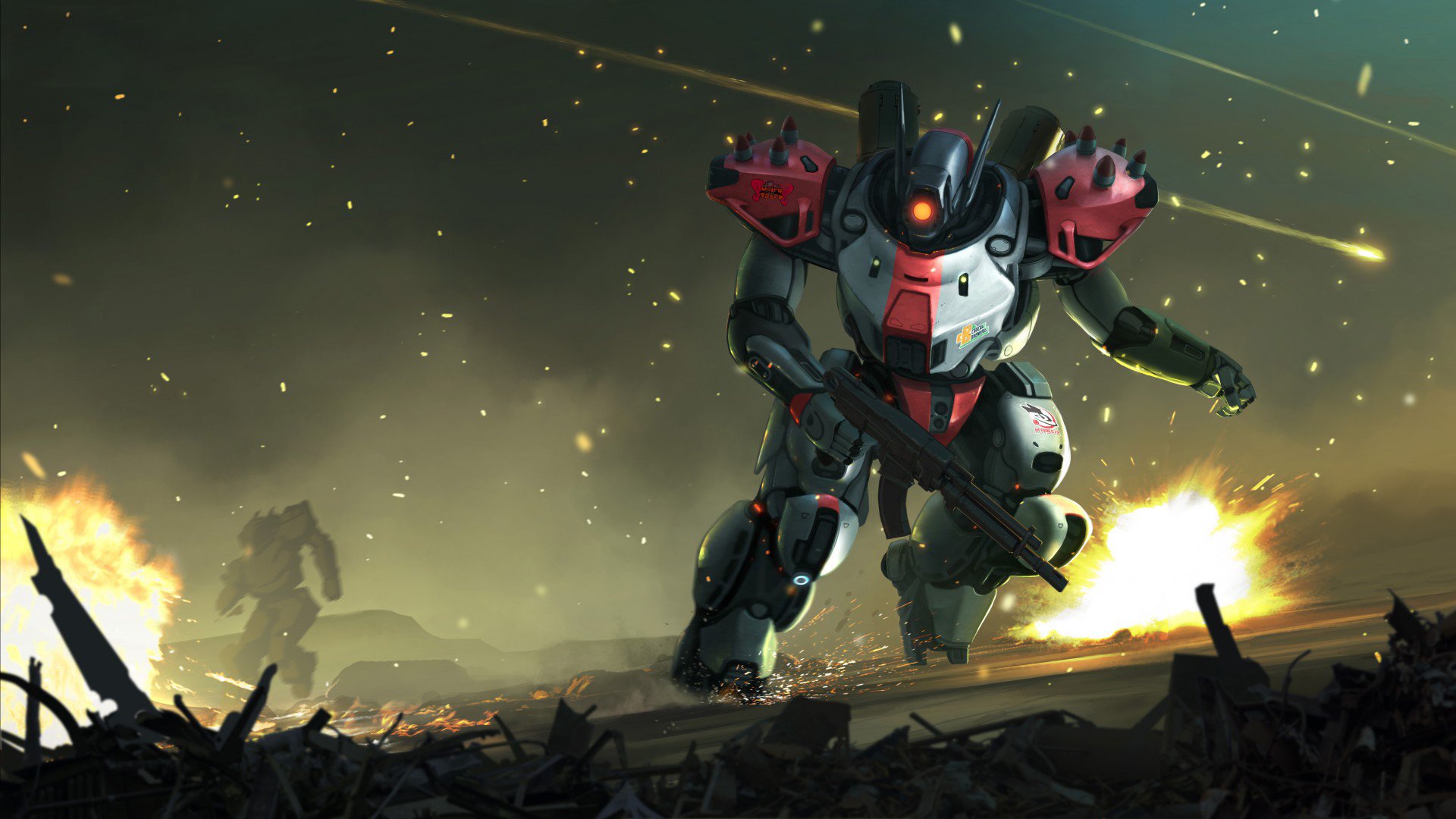
On the edge of inhabited space, the dogged Rebels fight for freedom against the oppressive Conglomerate--a ragtag alliance of homesteaders and outlaws against the might of Earth's military-industrial complex. You are mercenaries, loyal only to your ideals, your comrades, and the almighty credit, driven in these bloody times to make your mark on history or just a profit. Your weapons are mobile frames, 6-meter-tall humanoid vehicles piloted via neural interface. You operate as agile light cavalry, tougher and packing more firepower than infantry, faster and more flexible than tanks and other heavy armor.

You've got a job to do. This is how.

The Basics

You're a skilled military operator with broad competence. When you have the time and tools you need and no one's opposing you, you can do most things without a problem.

When success is uncertain, roll a d6. The referee will set a target number--usually 4, but it might be lower or higher for easy or really difficult tasks. If you meet or exceed the target number, you succeed.

If you're an expert, roll an extra d6 and take the highest. If you're a master, roll 2 extra d6 and take the highest.

Creating a Merc

You're a proficient operator and frame pilot. If your background includes other training, education, or experience, you have those skills too. Choose 2 skills that you're an expert in. Some examples:

  • Aerial/orbital insertion
  • Artillery
  • Assault weapons
  • Camouflage
  • Close-quarters combat
  • Communications
  • Cyberwarfare
  • Demolitions
  • Field medicine
  • Field repair
  • Heavy weapons
  • Marksmanship
  • Urban ops
  • Wilderness survival
  • Zero-G ops

You're skilled in all of these things; expertise reflects areas of special focus. You can also be an expert in non-mercenary skills, like if you have a degree in nuclear physics. You can't start your career as an expert mobile frame pilot--you're skilled, sure, but expertise comes with experience.

Introduce yourself to the rest of the company by name, pronouns, age, look, and known history. Your lancemates will give you a nickname that will serve as your callsign; you don't get to pick your own nickname, and if you try, you're an asshole. If you're joining an established company as a new recruit, your lancemates can wait to give you a nickname until you earn it.

Merc Equipment

You have access to common gear through the company armory; exotic stuff requires special expense. When you deploy for a mission, choose your load: light (4), medium (6), or heavy (8). At light load, you can blend in with civilians. At medium load, you look like an operator on a mission. At heavy load, you look like you're planning to take on an army, and you're not going to cover any cross-country distance on foot.

Most pieces of gear you can carry take 1 load. Big, heavy stuff, like full body armor or an assault rifle, takes 2. Really small stuff doesn't count. Distribute your chosen load as you like, then you're ready to head out.

Infantry Combat

Combat is played in rounds; each round, every combatant gets 1 action. The length of a round is flexible; in a quick, brutal close-quarters engagement, a round might be a few seconds, while in a protracted long-range firefight, it might be a few minutes. The important thing is that everyone gets to act once.

The side that engages first has the initiative; if it's uncertain, roll off. Ambushes and surprise attacks automatically win initiative, but don't give the ambushers a free round or anything. Everyone on the side with initiative acts, then everyone on the other side. You can choose to delay until after the enemy acts, but you can't act in between two enemies.

Distance in combat is measured in zones. A zone is the area with the same general terrain conditions and sightlines. The size of a zone is flexible; in a warehouse, the crate-strewn floor might be one zone and the catwalk overhead another, while in a firefight across a forested valley, each side of the valley might be a zone and the valley bottom another. During their action, a person can move as far as it makes sense for them to be able to given the length of the round, whether that's multiple zones or only a small part of 1 zone. Weapons can likewise extend as many zones as make sense based on visibility and the effective range of that weapon. (In a firefight inside a building, the limiting factor on a rifle isn't its theoretical effective range but the sightlines available.)

Your main defense against being shot is cover. Each zone might have no cover, light cover, or heavy cover available. When you use your action to take cover, you move to the best available cover and gain a cover rating based on how good it is: 4 for light, 6 for heavy. When someone shoots at you, that's the target number they have to roll to hit (d6, same as usual). Hit or miss, each shot reduces your cover rating by 1. To regain cover, you'll need to spend another action repositioning and taking cover again, which resets your rating to the best available in the zone.

Defending against a melee attack is a d6 roll opposing the attacker.

When you hit a target, you roll your weapon's damage die and reduce the result by their armor. The remaining damage inflicts wounds. 1 damage is a light wound, which gives you -1 to all rolls; light wounds heal with a week of rest in a secure location. 2 damage is a moderate wound, which is -2 to rolls and needs treatment to heal. 3 damage is a serious wound, which is incapacitating and fatal within minutes if not stabilized. 4 damage is instant death. Taking damage while wounded moves you up to more severe wound levels.

After shooting, roll your weapon's ammo die. On a 1, you're dry; switch weapons or spend an action and use a mag you're carrying to reload. Otherwise, reduce your die size by 1 next time you roll (d4 minimum, after that you run dry automatically).

Example weapons:

  • Combat knife: 0 load, d4 damage
  • Pistol: d4 damage, d6 ammo
  • Assault rifle: d6 damage, d8 ammo
  • Shotgun: d4 damage (d8 at close range), d4 ammo
  • Sword/entrenching tool/fire axe: d6 damage
  • Marksman rifle: d6 damage (+2 if you spend an action aiming), d6 ammo
  • Light machine gun: 2 load d8 damage, d12 ammo
  • Frag grenade: d8 damage to d4 nearby targets

Example armor:

  • Bulletproof vest, 1 armor
  • Infantry armor (2 load), 2 armor
  • Armored powered exoskeleton (2 load), 3 armor

Building Your Frame

For frontier pilots, rebel and mercenary alike, DIY is the name of the game. Most combat frames are assembled from modular and 3D-printed parts according to open-source patterns or the pilot's own design. As a result, every pilot's frame is unique. You take the systems and weapons you want, add on as much armor and ammo as you can, and put them all together to form your rig.

The biggest limiting factor is mass. A mobile frame can only support so much weight and bulk without being slowed down, and in frame combat, speed is life. You also need to consider your frame's power supply and the processing power of your onboard computer.

Frame mass is measured in slots. A light, agile frame has 15 mass to fill. A mid-weight frame has 20, and a heavy beast has 25. No frame can support more than 25 mass, and there's no real benefit to going below 15. Generally, each system you add to your frame takes 1 mass; heavy, bulky stuff takes 2, and some systems don't add any significant mass. A light frame can cover about 400 meters of open terrain in a minute; a medium frame can cover 300; a heavy frame can cover 200.

At minimum, a functioning frame needs 4 systems: the frame itself (meaning the mechanical skeleton and synthetic muscles the frame uses to move), the cockpit (where you sit), the power supply (which provides electricity to the frame and all its systems), and the onboard computer (which runs the neural interface that allows you to operate the frame). Each of these takes 1 mass. The rest of your mass can be allocated as you like to weapons, extra systems, ammo, or armor.

Write down your systems--frame, cockpit, power supply, computer, and any others--as a numbered list, starting from 1 and counting up. Systems that take 2 mass take up 2 lines; stuff that doesn't add mass is off to the side. Systems closer to the top are more internal, so they'll be the most protected; you should always put your vital systems at the top, probably starting with your cockpit. For example, for a midweight frame:

  1. Cockpit
  2. Power supply
  3. Main computer
  4. Frame
  5. Ejection system
  6. Chaff launcher
  7. Autocannon
  8. Rocket launcher
  9. Armor
  10. Autocannon ammo
  11. Autocannon ammo
  12. Armor
  13. Rocket launcher round
  14. Rocket launcher round
  15. Armor
  16. Armor
  17. Armor
  18. Armor
  19. Armor
  20. Armor

    Non-encumbering: 

  • Firewall software (1 processing, +2 hardening)

(This is known as the Dragoon pattern, a popular general-use combat frame throughout the frontier. If you're overwhelmed with all the options, the Dragoon is a good place to start.)

Your essential power supply provides 5 power. 3 of that is needed for the frame's basic functions, so you have 2 to spare. Systems that require power to run will take up some of that pool; if you need more power, you can take extra fusion batteries as systems for +5 power each.

Your main computer provides 5 processing. 3 of that is needed for the basic OS. Advanced software, like cyberwarfare programs, will take up more processing. You can add extra processors as systems for +5 processing each.

Describe the look of your frame and one distinctive piece of art or scrawled word you've painted on it.

Frame Defenses

Frames have 4 special defenses. Evasion protects against large explosions and similar area effects. Jamming protects against guided weapons. Insulation protects against EMPs and other electronic attacks. Hardening protects against cyberattacks.

Each defense is rated from 1 to 6. When you defend, you roll a d6 and try to roll equal to or under your rating. Evasion starts at 3 for light frames, 2 for medium, and 1 for heavy; all the others start at 1 for everyone. You can equip defensive systems to improve your ratings--ECMs for jamming, firewalls for hardening, etc. You can also use one-time countermeasures to automatically succeed on defense rolls, like launching chaff to throw off guided missiles.

Frame Combat

Frame combat works basically the same as infantry combat. The main difference is that instead of wounds, damage destroys your systems. When you hit with an attack, you roll your damage, and the target counts that many systems up from the bottom of their list; whatever's in that slot gets disabled. Hopefully that'll just be armor, but if it's a functional system, they lose it until it can be repaired or replaced. When counting up systems for damage, skip any that are already destroyed. If you hit their frame, power supply, or main computer, they're completely disabled and out of the fight; if you hit their cockpit, same, but they're probably also dead.

Rapid-fire weapons will often have multiple damage dice, written like d6/d6. That means you roll 2 d6, but don't add them together--instead, whatever each die rolls, that's what gets hit. So, if you roll a 2 and a 4, the systems they have 2 and 4 from the bottom of their list are destroyed. Explosive weapons will have damage marked with an e, like d6e; that means a hit with that weapon also destroys everything below the hit system. So if you roll d6e and roll a 3, the target counts 3 systems up from the bottom of their list and loses all those systems. Explosives are scary.

If an attack hits ammo you're carrying, the ammo has a 50% chance to explode, destroying everything above it until it hits armor. The armor is destroyed, but it stops the explosion. Smart pilots always put some armor in between their ammo and their vital systems.

You can purge any number of systems at will to free up mass. This can put you into a lighter weight category. Disabled systems still count toward your mass unless you purge them, but if you don't go back and recover them afterward, you obviously can't get them repaired and will have to buy replacements.

Example frame weapons:

  • Frame knife: no mass, d4 damage
  • Heavy machine gun: d4/d4/d4 damage, d10 ammo
  • Frame saber: d6 damage
  • Autocannon: d6/d6 damage, d8 ammo
  • Howitzer: d8 damage, d4 ammo
  • Railgun: 2 mass, d8 damage (+2 if you spend an action aiming), d6 ammo
  • Rocket launcher: d10e damage, 1 shot
  • Tank gun: 2 mass, 2d6e damage, 1 shot

Example frame systems:

  • Attack software: 0 mass, 1 processing, target defends with hardening or loses 2 power until they act to restore systems
  • Autoloader:1 power, linked to a specific weapon, reload that weapon without using an action
  • Chaff launcher: 1 power, auto-success on a jamming roll, 1 use
  • ECM generator: 1 power, +2 jamming
  • Ejection system: 1 power, eject manually at will, 5-in-6 when frame disabled, ineffective if cockpit hit
  • Field repair kit: repair 1 disabled system for yourself or a nearby ally, depleted on 1-in-6 with use
  • Firewall software: 0 mass, 1 processing, +2 hardening
  • Insulated systems: 2 mass, +2 insulation
  • Jump jets: 1 mass and 1 power per frame weight class, jump up to 30m in atmosphere
  • Packet sniffer: 1 processing, cyberwarfare test to intercept enemy communications in target zone for 1 round
  • Satellite uplink: 1 power, 1 processing, use satellite imaging for bird's-eye view of the battlefield
  • Survival gear: enough rations, supplies, and portable shelter for 1 week in terrestrial conditions
  • Zero-G fitting: 2 mass, 2 power, move freely in space and enough air for 24 hours

Infantry vs. Frames

Frames are functionally impervious to small-arms fire. Infantry-portable heavy weapons, like rocket launchers, work against frames just like they do when mounted as frame weapons, although they're usually more cumbersome for infantry. When frames attack infantry, they attack a whole group at once rather than a single fighter; rapid-fire weapons inflict 1 casualty per damage die, and explosives inflict casualties equal to the damage roll. However, if there are friendlies in the same zone, extra casualties roll over to them.

Frames vs. Heavy Armor

Tanks and similar vehicles count as 1 target for frame attacks, and vice versa. A typical main battle tank has 40 mass. Tanks are scary monsters, but they can't go everywhere frames can go. Taking them down requires clever tactics or a lot of luck.

Saturday, February 4, 2023

Under Stone and Over Hill

I've been working on a new build of my hack, and now it's back to a point where I feel good about it. I'm not trying to do anything revolutionary; this is basically just my personal DM binder, presented in a hopefully somewhat readable form for my own reference and maybe yours.

Goals

I dunno, same as everybody else's, "do OSR exactly the way I like." I've come to accept that there is really only One OSR Game that everyone plays basically the same way for the same reasons, and all the little differences between OSR systems are just for our own idiosyncratic preferences, convenience, and the fun of hacking for hacking's sake. This is my B/X hack; there are many like it, but this one is mine.

Selling Points

  • Slim 6-page main rules (plus gear tables and spell lists in appendices)
  • Quick, decision-light character creation
  • Classless, organic advancement based on character actions rather than static levels
  • Simple, immersive damage and wound system that allows characters to grow tougher while still keeping high-level combat tense
  • Qualitative range and distance--no grid maps needed

Sunday, January 29, 2023

Normal Humans

The subject of the "normal human" monster entry in the OSE rulebook came up in the OSR Discord. I started riffing with Carson and this happened.

Normal Human

A normal human. Just a normal human. Just a perfectly normal human.

Lady Apidae by Nandrysha

HD 1 (4 HP), AC 12 or worn armor, speed 30', 1 weapon attack, morale 7.

A Normal Human always rolls the average result on every die, rounding whichever way benefits it most.

Normal Humans are all but impossible to detect in groups. When entering a crowd of more than 10 people, a Normal Human has a 3 in 6 chance to blend in flawlessly (and since they always roll average, this roll always succeeds). However, any PC with at least 10 Wisdom will feel an indefinable wrongness when interacting with a Normal Human on its own.

If you tell a Normal Human your real name of your own free will, it will begin to steal it. Each day, every numeric value on your character sheet--ability scores, hit points, etc.--will move 1 closer to average. When they all reach average, you become a Normal Human permanently, and the Normal Human that stole your name replaces you completely. Killing the Normal Human trying to steal your name before the process completes halts it and reverses the effects, but finding the specific Normal Human you need to kill is always harder than it should be. You could've sworn this was the right one, but it must have been another one--they're so hard to tell apart....

Saturday, January 21, 2023

Thoughts on Moldvay Basic, Part the First

I figured it was about time I got around to actually reading B/X. It's always held up as the lingua franca of OSR, after all, and no matter how different I want my own rules to be, I feel like I should be familiar with what we're all ultimately referring back to. I've played OSE before using the free player quickstart rules, but that's my only exposure. I'm not going to do a full review or anything, but I figured I'd jot down some things that stood out to me as I went.

I'm reading the Moldvay version of the Basic Rulebook, pdf purchased from DriveThru. I like the art, and it's cool to see a lady magic-user as the adventurer of primary focus doing cool shit, even if that dress is...yeah.

Part 1: Introduction

I actually really like how the book explains the basic concept of the game, what it's about, the roles of the players and DM, what winning and losing mean and don't mean. It's fairly concise and gets the important stuff across well. I guess I assumed stuff this far back would have clunky ways of explaining all this stuff, since I still think of RPGs as a New Thing at this point and assume, I guess, that a lot of the language we use to describe it now still didn't exist.

The fact that all creatures besides the PCs are technically considered monsters is hilarious to me. Especially since the book explicitly says "yeah, totally normal humans you meet in a dungeon are absolutely monsters." Also interesting is the fact that the book calls out talking to "monsters" in the exact same way it does stealth or combat, not just as a "hey, once in a while you might meet monsters that are willing to negotiate." Like, it seems to suggest it's totally viable to play the game intending to talk and negotiate with just about everything you meet in the dungeon. I knew talking to monsters was always part of things, but I hadn't thought of it as something people would expect to be doing as much as or more than fighting or evading stuff.

The fact that the book needs to devote an entire section to explaining all the different ways it uses the word "level" is also hilarious.

Part 2: Player Character Information

The way the book talks about ability scores definitely doesn't give me the impression that they're not supposed to matter. I know by this time, ability scores have much broader mechanical effects than the very earliest version where I understand they literally only affected experience gain for certain classes. But still, hearing some people talk, you'd think making them do more is a newfangled concept.

The option to raise your prime requisite by reducing your other scores is also something I always forget about--I feel like I've only ever seen it reproduced in OSE. I'm not really sure why it seems so consistently abandoned otherwise. It seems like it doesn't interfere with what makes random ability scores good (quick to generate, no decision-making required, can inspire unorthodox characters), it's not super fiddly, and it's surprisingly grounded in the fiction as explained by "you train to improve at one thing and sacrifice development in others." I kind of like it. Probably still just keep my "swap two scores if you want" that I stole from LotFP, but still.

Okay, I'll defend thieves as a class all day, but yeah, the thief skills as implemented in here fucking suck. "Hear noise," so only thieves can say, "Hey, I'm being quiet and listening for monsters coming?" Most of them you can at least justify by them being specialized skills (lockpicking, picking pockets) or saying thieves can do them under exceptional circumstances or are just better at them than everyone else (hide in shadows, climb walls), but listening, really? Come on.

Reading the cleric makes me think I need to start treating undead as more special. So many dungeons put skeletons everywhere as the standard mook enemies. I've done it. Though my current setting doesn't really have undead anyway.

Halflings having Strength as a prime requisite is again hilarious.

I can't believe magic-users can't use staves as weapons here. If anything, that seems way more iconic than daggers. Though thinking about it, I actually don't even know if there are rules for staves in this book.

"[Thieves] do steal--sometimes from members of their own party." Oh, they...actually just say it. Welp.

I was prepared for the alignments to be less stupid than they're sometimes made out to be; they are not, and honestly even worse than I expected. "A Chaotic character does not work well with other player characters"--why have it as an option, then? I guess people saw player conflict as a more normal part of the experience? I dunno, I don't mind PvP in something like Apocalypse World because in that game, players have ways to avoid losing their character in a way that isn't interesting to them. In OSR, having to be prepared for my PC to be murdered by somebody else's doesn't sound like a fun addition to things, the game's already deadly enough. I feel like if you wanted to have this style of alignment, it'd be best to establish it as something the players should hash out amongst themselves and come to an agreement on what they're open to--a fully Chaotic party could be a great time if everyone knows that's what they should expect. 

I still can't wrap my head around alignment languages. Best explanation I can come up with is that they're just meant to facilitate communication between PCs and monsters, to avoid too many cases of the PCs wanting to talk to something but not sharing a language with it. But it still feels goofy to me. And situations like the one avoided by alignment languages can present an interesting challenge--how do the PCs communicate to a monster that they want to parlay without a shared language? How do they make themselves understood? Those are answerable questions. I want players to describe their characters scratching pictures in the dirt with a stick to communicate with the deep faeries, that sounds awesome.

"Note that playing an alignment does not mean a character must do stupid things. A character should always act as intelligently as the Intelligence score shows..." (Emphasis mine.) Hmm, evidence of an intention that characters be defined in the fiction to some extent by their ability scores, in contrast with the attitude some OSR folks seem to adopt today. I'm biased, of course, since I like ability scores.

Oh, no combat staves listed in the weapons, yup. I feel like Gandalf definitely thwomped someone with his staff at some point, but I haven't read the books in a while.

I'll try and continue with the rest of the book in further posts.

Thursday, January 19, 2023

My (Better) Damage Mechanics

I'm alive.

I don't like hit points. They're fictionally confusing (meat points, etc.), and worse, they're boring. You always know how many HP you have, and that means you always know exactly how much damage you can survive. As you level up, combat becomes theoretically more survivable, but also consistently takes longer while you and your opponent remain equally matched. I don't like players being able to rely on that; a fair fight should never be that safe or predictable.

This is what I'm going to use instead from now on.

Damage

Hit points no longer exist. Damage still works the same way: attacks deal points of damage equal to the roll of a damage die (or dice) based on the attacker's weapon. A dagger deals 1d4 damage; an axe, spear, staff, or arrow deals 1d6; a sword deals 1d8 (because of its bigger cutting edge than an axe--the downside is that it's way more expensive, not useful as a tool, can't be thrown, etc.); a two-handed polearm, battleaxe, or longsword deals 1d10.

Wounds

Instead of taking away HP, damage causes wounds. A wound is always a physical injury in the fiction--if you're wounded, you've been cut, bruised, burnt, or whatever in a concretely established way.

Normal humans have 4 wound slots: 1 light, 1 moderate, 1 severe, 1 critical (named so as to correspond with the standard Cure spells). Light wounds are painful and hampering, but will get better on their own with time and rest. Moderate wounds are more painful and hampering and need treatment to heal, but aren't life-threatening. Serious wounds are "you're bleeding out": you're unconscious or otherwise incapacitated, and if you don't get help within the next few minutes, you'll die. Critical wounds are certain death--if not instant, then imminent enough to leave time for little more than dramatic last words, and beyond the help of any healer.

Each point of damage fills a wound slot. If you're unharmed and take 1 damage, you become lightly wounded; 2 damage, moderately wounded; 1 and then another 1, moderately wounded. When you're lightly wounded, you take -2 to all ability checks, attack rolls, and saves. When you're moderately wounded, you take -4. When you're seriously wounded, you go down and can't do anything more strenuous than crawl; if you aren't stabilized within 1+Con modifier minutes (minimum 1), you bleed out and die (you can also make one last dramatic attack or check, but then you die immediately). A PC with medical skills can stabilize a serious wound with medical supplies and a successful Int check; this takes a turn, during which the patient doesn't bleed out, but if the healer fails, the patient dies when the turn ends. A stabilized character is still seriously wounded; they can stand up and walk, but nothing more strenuous than that (which includes carrying a heavy load of gear).

Note that all this means being stabbed with a dagger has even odds to fatally wound you and a 1-in-4 chance to kill you outright (assuming the attack hits). A single spear thrust has a 2-in-3 chance to fatally wound and even odds to kill instantly.

Hit Dice

Everything that would normally have hit dice (so PCs, humans other than 0-level commoners, and monsters other than those with 0 HD) still does. Instead of rolling your HD to determine your HP, you keep them as a pool of dice.

When you get hit, before damage is rolled, you can spend any number of your HD to try and turn the blow. Roll those HD, add your Con modifier to each, and reduce the damage of the attack by the total. Any damage that gets through wounds you. All HD you roll are "exhausted." When you rest in a relatively safe, comfortable place for a night (so outside of the dungeon), you regain all exhausted HD.

Exhausting HD represents fatigue, minor scrapes and bruises, and diminishing luck, the way losing HP normally does when they're not used as meat points. The difference is that you can never know exactly how much luck you have left. If you're a 6th-level fighter up against a farmer with a spear, you can fight conservatively by only spending 1 HD each time the farmer hits you, but he might still get a lucky jab past your guard (you roll low on your HD, he rolls high for damage) and end you right there. The only way you can be completely sure of your safety (assuming you have a Con modifier of 0) is to blow all 6 of your HD the first time he lands a hit, leaving yourself exhausted and vulnerable if he manages to hit you again. If you're up against another 6th-level fighter, things become even less predictable--even if you both fight conservatively, the duel might drag on for many rounds or end in a single lucky strike.

This is a lot of text, so have some Berserk to break it up. Guts is probably fucked here
even with normal HP, but with these rules, he's fucked sooner.

Recovery and Healing

A light wound will heal in a week of normal (non-adventuring) activity, minus days equal to your Con modifier.

A moderate wound needs treatment to begin healing. A PC with medical skills can do this with medical supplies and an hour's work, or you can go to a doctor. Once treated, a moderate wound becomes a light wound after d6-Con modifier weeks (minimum 1) of non-adventuring activity, at which point it heals as a light wound. If you spend your recovery time on full bed rest under the care of a skilled healer, it's d4 weeks instead of d6.

A serious wound that's been stabilized can be treated like a moderate wound, and heals the same way (after which it becomes a moderate wound, which then has to heal up to a light wound). However, serious wounds leave lasting marks. Whenever you're treated for a serious wound, reduce a random ability score by 1d4 and gain a distinctive scar. (I'd ignore the ability score loss if your rules don't have PCs' ability scores increase as a standard thing; the new version of my hack I'm working on probably will, so this is meant as the main counterbalance to that.)

Instead of their normal effect, Cure spells heal wounds of their corresponding level immediately, skipping past the levels below to restore the subject to full health. Cure Serious Wounds doesn't prevent ability score loss (if you're using it) or scarring. A Cure spell won't do anything for a wound greater than its effect--Cure Light Wounds can't reduce a moderate wound to a light wound. Even magic has its limits. As a tradeoff, because wounds don't scale with level like HP, all Cure spells stay consistently useful at all levels, instead of Cure Light being obsoleted by Cure Moderate and Cure Serious.

Next Time

Like I mentioned, I'm working on a new build of my hack. I kind of want to put it in zine form this time; regardless, I'll probably post it here in full once I have it in something like a usable state. Meanwhile, I'd like to start putting some of my general rules ideas up here. Stay tuned if you like reading the words that come out of my head.

A Few Spells for Summoning Daemons

Summoning magic is something I've wrestled with for a long time. On the one hand, I want it to be flexible, because a diversity of weird...